Measuring the Return Loss of a Coaxial filter with an RTL Key , a Noise Generator an SWR Bridge , some software and a laptop
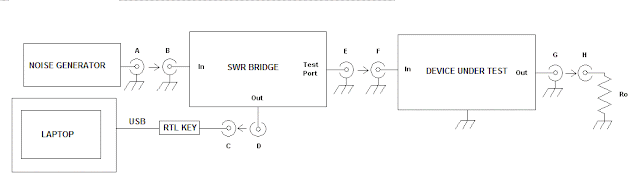
I ended now to test the possibility to measure the Return Loss of a coaxial filter with some simple tools , like an RTL Key , a Noise Generator and a SWR Bridge , a software and a laptop . I have used the following setup : And two different software : A) HDSDR ( that we already have used in three video for pointing satellites , measuring the satellite Beacons and check and measure in the FM band ) : https://www.hdsdr.de/ B) SATSAGEN from Alberto Ferraris : https://www.albfer.com/satsagen-download-page/ The results are in the following pictures : HDSDR : Much faster , but easy to saturate , limited span and limited markers possibilities SATSAGEN : Much slower , but difficult to saturate , no limited in higher span , big facilities on markers At the end , at these frequencies and for these amplitude ranges , with SOME PATIENCE AND SKILLS, the results are quite "similar" to that of a professional HP instrument as follow : Of course...
